
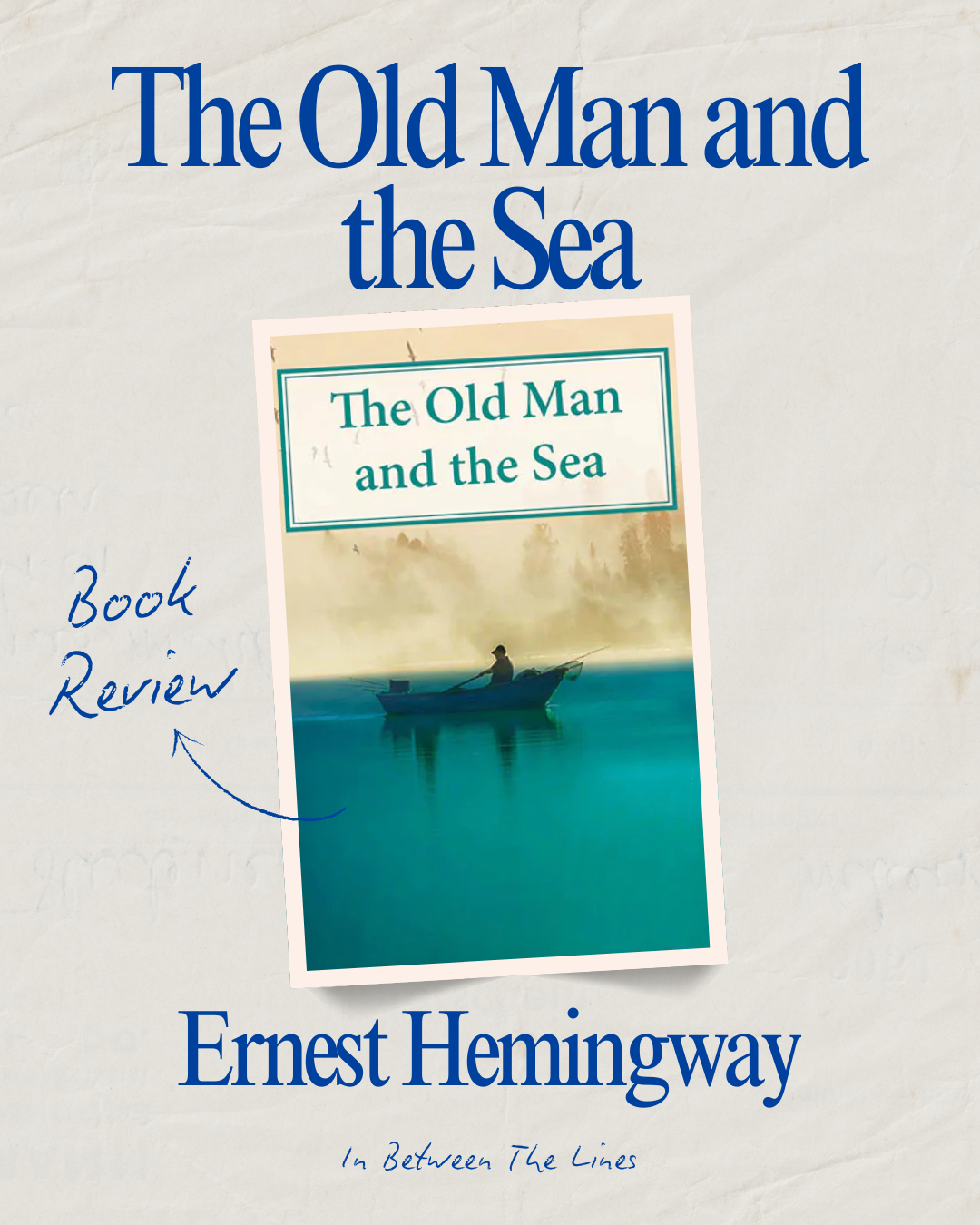
“Now you are getting confused in the head, he thought. You must keep your head clear. Keep your head clear and know how to suffer like a man. Or a fish, he thought.”
For every ten seconds captured by our senses, Hemingway stretches time across ten pages. He is an observer above all, even before being coined a storyteller. To say that nothing happens in The Old Man and the Sea is to say that nothing happens in a day. It would minimize the significance of anything unless it’s explosive, euphoric, or tragic. Hemingway refuses this approach. He draws the mundane into focus and treats it as the true terrain of life, the space in which everything between birth and death unfolds. Every movement, every task, carries extremes that are packed with feeling. Life, in Hemingway’s vision, does not make sense apart from man, and man does not exist apart from primal struggle.
Dignity in this novel is conditional. It comes only through resistance, endurance, and often times, comparison. To earn respect, one must fight back, and its value depends entirely on the intensity of that struggle. Santiago understands that suffering ultimately gains meaning when witnessed:
“If the others heard me talking out loud they would think that I am crazy,” he said aloud. “But since I am not crazy, I do not care.”
Physical weakness carries shame differently depending on its witness. Some failures humiliate when seen by others, but private pain tests self-respect:
“I hate a cramp, he thought. It is a treachery of one’s own body. It is humiliating before others to have a diarrhoea from ptomaine poisoning or to vomit from it. But a cramp, he thought of it as a calambre, humiliates oneself especially when one is alone.”
Hemingway links human honor to relational recognition: respect emerges only through resistance, and empathy through resemblance. This perspective is passed on to his characters as they navigate the endurance of said struggle.
Hemingway’s fascination with Spanish-speaking cultures, evident in references to Spain and Cuba, shapes the world of The Old Man and the Sea. The scattered Spanish terms and attention to ritual as tradition reflect an understanding of these cultures rooted in lived experience. Masculinity never exists without a counterweight. The sea is “la mar” when it is loved, capricious, or governed by the moon, and “el mar” when it is forceful and antagonistic. Holy Fathers are harder to recall than Hail Marys. Luck, like the breeze (la brisa), is feminine when it is absent and something to be bought after days without it. These oppositions never exist independently. Meaning and morality are contingent on perspective and relation, never inherent.
The old man populates his world with companions rather than abstractions. His hands and the stars are his brothers. The bed is his friend. The fish is not merely prey but an entire microcosm that exists alongside humanity, sometimes for or because of it. Early in the story, Santiago avoids embracing the young boy’s help, insisting he can still manage on his own. Yet as his bad luck continues and he struggles alone at sea, he begins to miss Manolin’s presence. In the midst of desperation, he calls out for him, showing that companionship, rooted in basic human need, counts as a primal instinct alongside the fight for survival. Hemingway never argues. He simply observes, allowing power relations to surface as though they were natural or inherent, removing himself as the author.
When the fish are weak, the old man holds unquestioned authority. When they prove strong, they shift into aspirational figures, invested with moral weight. The fish functions as a mirror, and it reflects the traits the old man values in himself. Hemingway writes, “Maybe he suddenly felt fear. But he was such a calm, strong fish and he seemed so fearless and so confident. It is strange.” The fear is not the fish’s but the old man’s recognition of an equal, and the admiration that follows is inseparable from self-regard.
He acknowledges the fish’s dignity aloud: “But you have a right to. Never have I seen a greater, or more beautiful, or a calmer or more noble thing than you, brother.” Brotherhood emerges from resemblance, as the fish earns dignity by embodying the very traits the old man values in himself.
Hemingway frames the battle of fishing as he frames bullfighting, a ritualized dance of respect and skill in which man and animal show courage and precision. To him, bullfighting embodies the fundamental struggle between human and animal. As Santiago tires and loses control of his strength and mind, the fight becomes a test of endurance and character for both him and the fish.
The prose mirrors the struggle, precise and attentive to every minor detail, as when “the fish came alive, with his death in him, and rose high out of the water showing all his great length and width and all his power and his beauty.” The fish is most alive at the moment of its death, not because it is dying, but because it has proven itself worthy. It does not matter how big the animal is, the struggle remains spectacular in Hemingways eyes. And his efforts of getting the reader to gain and share that perspective only grow as the novel progresses.
Santiago sympathizes most deeply with the creature while fighting it, exemplifying relational virtue. When the fish is struck, it is as though the old man himself were struck. The boundary between man and animal collapses not through compassion but through identification.
“You were born to be a fisherman as the fish was born to be a fish,”
“You did not kill the fish only to keep alive and to sell for food. You killed him for pride and because you are a fisherman.”
Hierarchy in the novel extends beyond land. The only creature the old man grants sustained empathy to after the marlin is the shark. “The shark was not an accident. He had come up from deep down in the water as the dark cloud of blood had settled and dispersed in the mile-deep sea.” The old man respects the shark for its power and dominance; it kills without rival. “This was a fish built to feed on all the fishes in the sea that were so fast and strong and well armed that they had no other enemy.”
In Hemingway’s moral universe, power exists only in relation to an opposing force, and the shark demonstrates this principle. Strength comes from what one overcomes, seen repeatedly in arm-wrestling, scorekeeping, and contrasts of youth and age, fish and fisherman, hunter and hunted. Juxtaposition defines dignity and strength relationally, shaping how characters understand worth and, at times, purpose.
Hemingway does not resolve the moral tension this admission creates. He leaves it suspended, as he leaves so much else suspended, trusting endurance to carry meaning where explanation might fail. Even at rest, the old man dreams of lions. Not survival. Not peace. Only primal strength. In this vision, dignity is never secured or possessed outright. It exists only in relation to what resists us, and fades the moment that resistance is gone.


Leave a Reply