
Ages 7-16 edition

Ottoline and the Yellow Cat
by Chris Riddell
I want to deeply thank Chris Riddell for writing and illustrating this incredible story. I remember feeling like I owned gold when I got this book at the age of seven. It is creativity at its peak. Calling it beautiful feels almost too simple for what this book is.
It even comes with postcards, and the illustrations made me want to write and illustrate my own book, just like this author.
Please let me know if you’ve read this one!

Escaping the Giant Wave
by Peg Kehret
This book truly is the reason that I understood how reading could be enjoyed. I had always enjoyed the idea of reading but at 11, reading became discouraged. By my peers, of course. No one else would have. Reading simply wasn’t something you did outside of assignments or classroom reading.
This book, however, was the first to make me visualise the text and understand what it meant to want to get back to reading throughout the day.
The main character, Kyle, is a 13-year-old on holiday with his family when an earthquake hits. The story, told through Kyle’s perspective, follows the aftermath of the catastrophe as he and his sister run from a tsunami mounting behind them.
This book was also the reason I entered my “natural disaster phase,” and it remains the best I have ever read in its genre.

The Boy in the Striped Pyjamas
by John Boyne
This groundbreaking novel is a necessary read for educational, historical, and empathetic purposes. I first read it at the age of eleven, and it made a very sensitive young girl feel everything far too deeply. I watched the film adaptation immediately after.
By then, everyone had already read The Diary of Anne Frank and seen Schindler’s List and The Pianist. But the cruelty in this story, shown through the most innocent perspective, shattered me as it has many others.

A Bad Boy Can Be Good For a Good Girl
by Tanya Lee Stone
This isn’t a book I would necessarily bring up in conversation. I’ve read it a couple of times since, and it’s not bad, but the reason it’s on this list goes beyond its quality.
I first got it as a freebie in a magazine when I was 12. It was the first book I had ever finished in one sitting (it was written in poetry format and could be read in 30 minutes) and I was completely engulfed in it.
The story follows three high school girls who discover they’ve all been dating the same person, someone who has tried to seduce nearly everyone in school. A fuckboy.
I loved this story. It discussed sex, cheating, and firsts, topics that I had no come across in books before. And reading it in the midst of puberty definitely heightened its impact on me.
I still have it on my bookshelf, and I can see it from when I’m sitting.

The Hunger Games Series
by Suzanne Collins
I was 12 years old, and this series deserves its own review, analysis, and essay.

Divergent
by Veronica Roth
This was everyone’s Hunger Games to Divergent, Maze Runner, 5th Wave pipeline. I am certain that I do not have a unique perspective on reading this series at 12-13. It also deserves its own review, analysis, or essay.

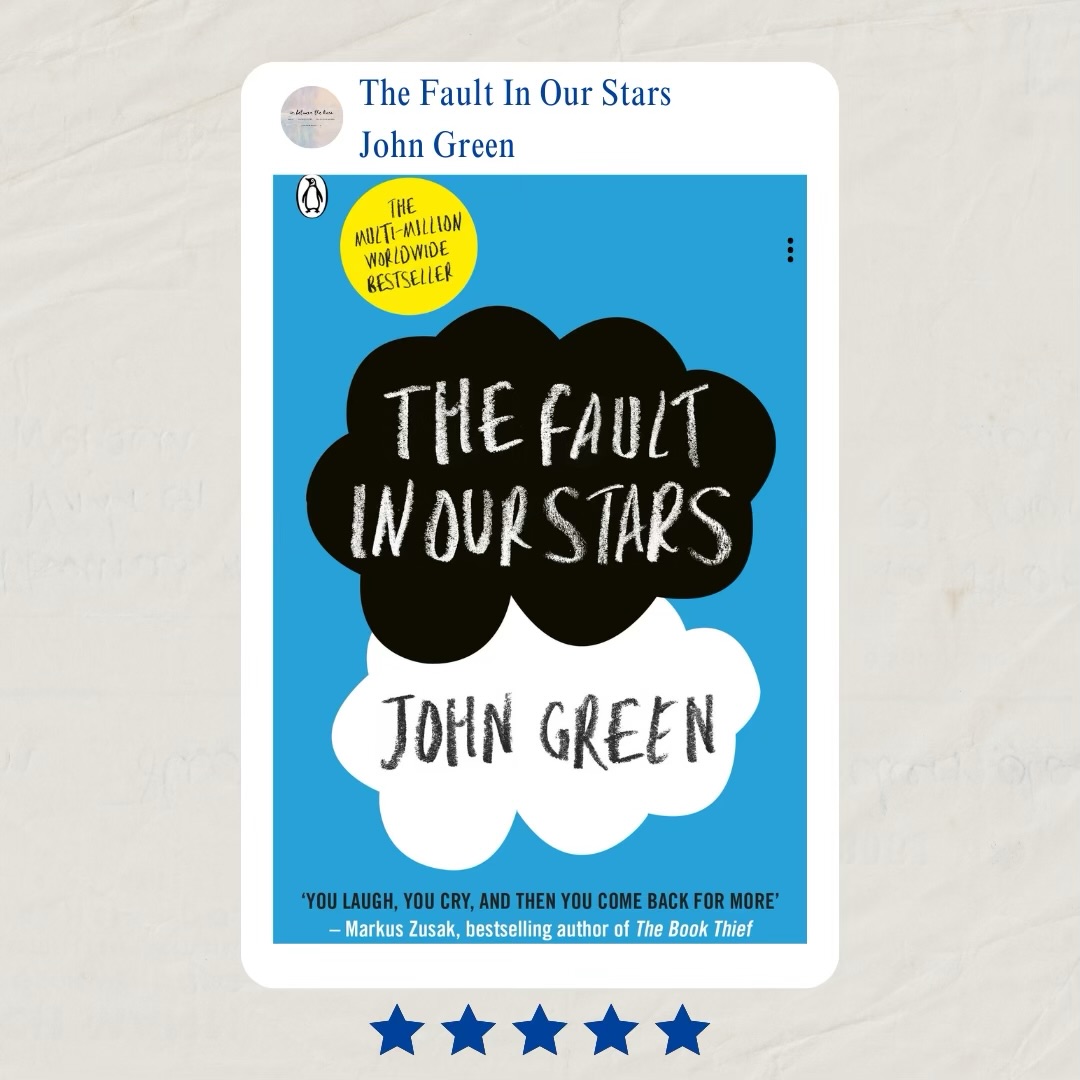
The Fault In Our Stars
by John Green
Up until this book, my only experience of fangirlhood had been through Justin Bieber.
When I first read it, I wanted to keep it completely to myself. I then gave my English teacher my copy and asked her to read it. The next day, she looked at me and said, “Why didn’t you warn me? I wouldn’t have read it in a coffee shop if I had known.”
A few days later, the book was in my school library. Then it was all over Tumblr, and eventually in my friends’ group chat. I fully embraced it when I saw the film adaptation announcement.

Anna and the French Kiss (series)
by Stephanie Perkins
Anna, Lola, and Isla changed my perception of reading romance. I had no idea that YA was even a genre until I discovered BookTube at 14. For months, I exclusively consumed bookshelf tours, TBR lists, and Read-a-Thon videos. This series appeared in everyone’s content, and I understood why as soon as I read it.
After finishing the trilogy, I bought a new bookshelf because I knew I was going to keep reading until I felt that same feeling these stories had given me.
Rainbow Rowell’s Eleanor & Park and Fangirl, Morgan Matson’s Amy & Roger’s Epic Detour, and Jandy Nelson’s I’ll Give You the Sun soon followed, filling up three shelves I still treasure.

All The Bright Places
by Jennifer Niven
…And then I read this. I felt grief in a way I had only experienced a few times by the age of sixteen. All the Bright Places was published in 2015, at a time when books began to resurface the conversation around mental health in romance, and it seemed to happen all at once. My Heart and Other Black Holes by Jasmine Warga was published just months later, as was Every Last Word by Tamara Ireland Stone.
Earlier titles like The Perks of Being a Wallflower by Stephen Chbosky (1999), It’s Kind of a Funny Story by Ned Vizzini (2006), and Thirteen Reasons Why by Jay Asher (2007) became pillars of the genre. They brought mental health awareness to the forefront and offered readers a lens of empathy and understanding through which to view it. It was the central topic of a majority of popular media.
Meanwhile, series like Skins and movies like Cyberbully (2011), which you could find on TV or YouTube at the time, showed how the genre was spreading into all mediums. Stories about suicide, self-harm, and mental health were discussed with a sense of reality. Books that appeared around 2014, like The Fault in Our Stars, added an air of romance and hope.
The Perks of Being a Wallflower was adapted into film in 2012. 13 Reasons Why became a Netflix series in 2017, only two years after this new wave of YA mental health stories surged in popularity. All the Bright Places was adapted into a film in 2020, proof that the genre remains strong, although the demand for this content is no longer as high as it was at the beginning of many of our reading journeys.

Did any of these books leave a mark on your childhood or teenagehood?
I’d love to hear your stories,


Leave a Reply